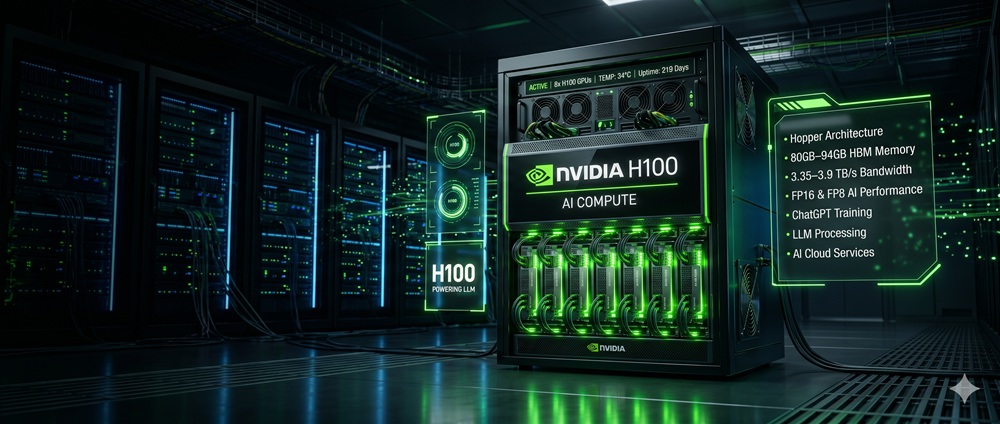
Technical Specifications
architecture
NVIDIA Hopper
gpu memory
80GB HBM3
memory bandwidth
Up to 3.35 TB/s
tensor cores
4th Generation
transformer engine
FP8 Supported
precision
FP64, TF32, FP32, BF16, FP16, FP8, INT8
interconnect
NVIDIA NVLink 4.0
pcie
PCIe Gen5
mig support
Up to 7 Multi-Instance GPU (MIG) Instances
deployment
PCIe, SXM
software
CUDA, cuDNN, TensorRT, NVIDIA AI Enterprise, NCCL
ideal for
Large Language Models (LLMs), Generative AI, AI Training, AI Inference, Machine Learning, Deep Learning, High Performance Computing, Scientific Computing, Computer Vision, Data Analytics, Cloud AI Infrastructure
Overview
The NVIDIA H100 Tensor Core GPU is built on the revolutionary NVIDIA Hopper architecture and is designed to accelerate the world's most demanding AI, machine learning, high-performance computing (HPC), and data analytics workloads. It delivers exceptional performance for enterprise AI infrastructure, cloud computing, research institutions, and large-scale datacenters.
Equipped with up to 80GB of ultra-fast HBM3 memory, 4th Generation Tensor Cores, FP8 Transformer Engine, and NVIDIA NVLink 4.0, the H100 significantly improves AI training and inference performance while reducing training time and infrastructure costs. It is optimized for modern AI applications including Large Language Models (LLMs), Generative AI, recommendation systems, computer vision, natural language processing, scientific simulations, and enterprise analytics.
The NVIDIA H100 enables organizations to process massive datasets, train trillion-parameter AI models, and deploy real-time AI services with industry-leading performance, scalability, and efficiency. Whether deployed as a single GPU server or within large multi-GPU clusters, the H100 provides the computational power required for next-generation AI innovation.
Key Features
• NVIDIA Hopper Architecture
• Up to 80GB HBM3 High-Speed Memory
• 4th Generation Tensor Cores
• Transformer Engine with FP8 Precision
• NVIDIA NVLink 4.0 High-Speed Interconnect
• PCIe Gen5 and SXM Deployment Options
• Multi-Instance GPU (MIG) Support
• Enterprise-Class Reliability and Scalability
Ideal Workloads
• Large Language Models (LLMs)
• Generative AI Applications
• AI Training & Fine-Tuning
• AI Inference at Scale
• Machine Learning & Deep Learning
• Computer Vision
• Natural Language Processing (NLP)
• Scientific Computing
• High Performance Computing (HPC)
• Data Analytics & Business Intelligence
• Financial Modeling & Risk Analysis
• Healthcare & Medical Research
• Autonomous Systems
• Cloud AI Infrastructure
The NVIDIA H100 GPU is trusted by enterprises, hyperscalers, cloud service providers, universities, and research organizations worldwide. With industry-leading AI acceleration, exceptional memory bandwidth, advanced Tensor Core technology, and enterprise-grade reliability, the H100 is the preferred choice for organizations building modern AI infrastructure and high-performance computing environments. It delivers the performance required to accelerate innovation across artificial intelligence, scientific research, engineering, financial services, manufacturing, healthcare, and other compute-intensive industries.
Frequently Asked Questions
What is the NVIDIA H100 GPU used for?
The NVIDIA H100 Tensor Core GPU is designed for AI training, large language models (LLMs), generative AI, scientific computing, data analytics, and high-performance computing (HPC). It delivers exceptional performance using NVIDIA Hopper architecture and 4th Generation Tensor Cores.
How much memory does the NVIDIA H100 have?
The NVIDIA H100 SXM version features 80GB of HBM3 memory with up to 3.35 TB/s memory bandwidth, while H100 NVL offers 94GB HBM3 per GPU. These configurations are optimized for training and deploying large AI models and memory-intensive HPC workloads.
Why choose NVIDIA H100 over previous-generation GPUs?
Compared to previous-generation accelerators, the NVIDIA H100 delivers significantly higher AI performance through Hopper architecture, 4th Generation Tensor Cores, Transformer Engine, FP8 support, NVLink, Multi-Instance GPU (MIG), and faster HBM3 memory, making it ideal for enterprise AI and LLM workloads.