The NVIDIA RTX PRO 6000 Blackwell Server Edition is a high-performance professional GPU designed to bring together enterprise artificial intelligence, accelerated computing, visualization, rendering, and scientific workloads in a single data-center-class platform.
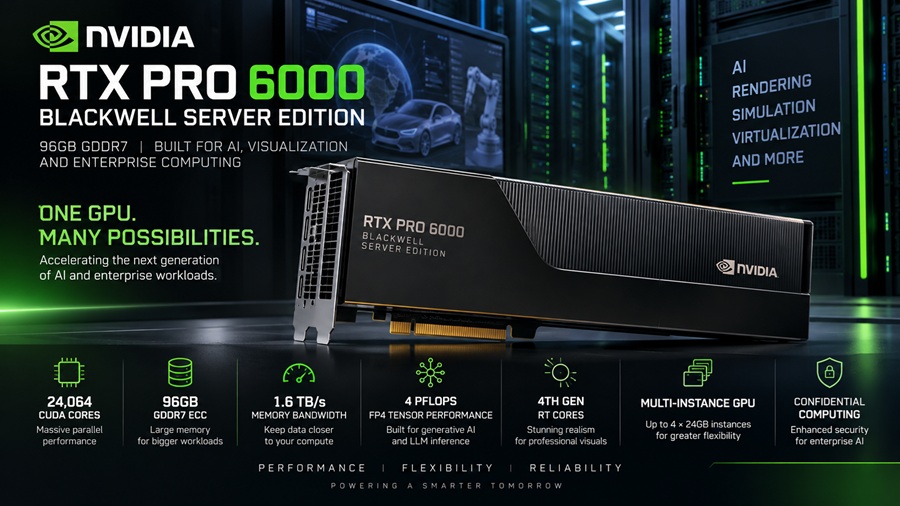
Built on NVIDIA's Blackwell architecture, the RTX PRO 6000 Server Edition combines 96GB of ECC-enabled GDDR7 memory, 24,064 CUDA cores, fourth-generation RT Cores, fifth-generation Tensor Cores, and nearly 1.6 TB/s of memory bandwidth.
The result is a GPU designed for workloads where large memory capacity, high compute performance, reliability, and virtualization are all important.
A New Class of Universal Data Center GPU
Traditionally, organizations often needed different accelerator platforms for AI, professional graphics, rendering, simulation, and virtual workstations. NVIDIA positions the RTX PRO 6000 Blackwell Server Edition as a versatile solution for these demanding workloads.
It is designed to accelerate workloads ranging from:
- Generative and agentic AI
- Large-language-model inference
- AI development and deployment
- Scientific computing
- Engineering and simulation
- 3D visualization
- Photorealistic rendering
- Digital twins
- Video processing
- Virtual workstations
- Industrial and physical AI
This combination makes the RTX PRO 6000 particularly interesting for enterprises that want to consolidate multiple GPU workloads onto a common server infrastructure.
96GB of GDDR7 Memory
One of the biggest advantages of the RTX PRO 6000 Server Edition is its 96GB of GDDR7 memory with ECC.
Large GPU memory is increasingly important as AI models, datasets, 3D scenes, simulations, and visualization workloads become more demanding. Instead of constantly moving data between GPU memory and system memory, applications can keep larger datasets directly on the GPU.
The GPU features a 512-bit memory interface and NVIDIA specifies memory bandwidth of approximately 1,597 GB/s, or about 1.6 TB/s.
Why 96GB Matters for AI
GPU memory capacity can often become a limiting factor before raw compute performance does.
A 96GB GPU can accommodate substantially larger models, batches, datasets, and workloads than mainstream GPUs with smaller VRAM capacities. It can also reduce the need to split workloads across multiple GPUs purely because of memory limitations.
For organizations deploying AI inference, development environments, embeddings, retrieval systems, computer vision, or multimodal applications, this large memory pool provides significant flexibility.
Blackwell Architecture
The RTX PRO 6000 Server Edition is based on the NVIDIA Blackwell architecture, NVIDIA's next-generation GPU architecture for AI and accelerated computing.
Blackwell introduces improvements across CUDA processing, Tensor Cores, RT Cores, memory technology, and AI-accelerated graphics.
The RTX PRO 6000 Server Edition includes 24,064 CUDA cores and 188 fourth-generation RT Cores. NVIDIA rates the GPU at up to 120 TFLOPS FP32, while its Tensor Core performance reaches up to 4 PFLOPS for FP4, 2 PFLOPS for FP8, and 1 PFLOP for FP16/BF16 workloads.
Key Specifications
| Specification | RTX PRO 6000 Blackwell Server Edition |
|---|---|
| Architecture | NVIDIA Blackwell |
| CUDA Cores | 24,064 |
| RT Cores | 188, 4th Generation |
| GPU Memory | 96GB GDDR7 ECC |
| Memory Interface | 512-bit |
| Memory Bandwidth | 1,597 GB/s |
| FP32 Performance | 120 TFLOPS |
| FP4 Tensor Performance | 4 PFLOPS |
| FP8 Tensor Performance | 2 PFLOPS |
| FP16/BF16 Tensor Performance | 1 PFLOP |
| TF32 Tensor Performance | 234 TFLOPS |
| Peak RT Performance | 355 TFLOPS |
| Interface | PCIe Gen 5 x16 |
| Maximum Power | Up to 600W, configurable |
| Thermal Options | Passive air / liquid-cooled configurations |
| Form Factor | Dual-slot FHFL air-cooled configuration |
Designed for AI Inference and Generative AI
AI inference is one of the most important applications for the RTX PRO 6000.
Modern enterprises increasingly need to run AI models continuously rather than simply train them. These workloads can include chatbots, recommendation systems, computer vision, document processing, code generation, multimodal AI, and enterprise AI agents.
The RTX PRO 6000 combines high Tensor Core performance with 96GB of GPU memory, making it suitable for demanding inference workloads.
Its large memory capacity is particularly useful for organizations running larger language models, AI agents, computer vision pipelines, and other memory-intensive inference workloads.
Multi-Instance GPU for Server Consolidation
Another important feature is Multi-Instance GPU (MIG) support.
MIG allows a compatible GPU to be partitioned into multiple isolated GPU instances. NVIDIA says the RTX PRO 6000 can be divided into as many as four 24GB instances.
This is useful for cloud providers, enterprise IT departments, AI development platforms, and GPU-as-a-Service providers that want to serve multiple workloads from a single physical GPU.
For example, a server containing an RTX PRO 6000 could potentially support multiple independent users or applications instead of dedicating the entire GPU to one workload.
Professional Graphics and Rendering
Although AI is a major focus, the RTX PRO 6000 is not simply an AI accelerator.
Its fourth-generation RT Cores are designed for professional ray tracing and graphics workloads. This makes the GPU suitable for applications such as:
- Architectural visualization
- CAD and engineering
- Product design
- Digital twins
- Film and television production
- 3D rendering
- Virtual reality
- Industrial visualization
- Simulation and visualization
The ability to combine AI acceleration with professional graphics processing is one of the major differentiators of the RTX PRO platform.
Virtual Workstations and GPU Virtualization
The RTX PRO 6000 Server Edition is also designed for virtualized environments.
NVIDIA lists the GPU for high-end 3D visualization, AI training, and inference workloads in its virtualization portfolio. It can be used with NVIDIA vGPU technologies to provide remote GPU-accelerated workstations and applications.
This allows organizations to centralize powerful GPU resources inside the data center while giving engineers, designers, developers, and other users access to GPU-accelerated environments remotely.
For enterprises, this approach can simplify workstation management while allowing expensive GPU hardware to be shared among multiple users.
Enterprise Security
Security is another important part of the Blackwell platform.
The RTX PRO 6000 supports NVIDIA Confidential Computing, which is designed to protect sensitive data and AI models while workloads are running.
This is particularly relevant for enterprises processing confidential datasets, proprietary AI models, financial information, intellectual property, or other sensitive workloads.
High-Density GPU Server Deployments
The RTX PRO 6000 Server Edition is designed for integration into high-density server systems.
Server platforms are available in configurations supporting multiple RTX PRO 6000 GPUs, including 2-GPU, 4-GPU, and 8-GPU systems.
An eight-GPU configuration can provide:
8 × 96GB = 768GB of total GPU memory
This makes multi-GPU RTX PRO 6000 servers particularly attractive for large AI inference, simulation, visualization, rendering, and enterprise computing workloads.
Power and Cooling Requirements
Performance at this level comes with significant power and thermal requirements.
The RTX PRO 6000 Server Edition can operate at up to 600W, with NVIDIA listing configurable power and different thermal implementations.
For server builders, this means the GPU should be paired with:
- High-capacity server power supplies
- Adequate PCIe power delivery
- High-airflow chassis designs
- Appropriate GPU spacing
- Proper rack-level cooling
- Sufficient thermal headroom
For dense multi-GPU systems, liquid cooling can become particularly attractive because it allows higher compute density within a limited rack footprint.
RTX PRO 6000 Server Edition vs. Workstation Edition
Although both GPUs belong to the RTX PRO 6000 Blackwell family and provide 96GB of GDDR7 ECC memory, the Server Edition is specifically designed for data-center deployment.
The Server Edition emphasizes server integration, virtualization, high-density deployments, and data-center thermal configurations.
The Workstation Edition is designed primarily for professional desktop workstations and uses a different thermal and physical configuration.
Choosing between the two therefore depends less on the underlying GPU architecture and more on the intended deployment environment.
Who Should Buy the RTX PRO 6000 Blackwell Server Edition?
The RTX PRO 6000 makes the most sense for organizations that need a combination of large GPU memory, AI performance, professional graphics, virtualization, and enterprise reliability.
AI Infrastructure Providers
GPU cloud providers can use the GPU for AI inference, model development, virtual workstations, and other GPU-as-a-Service workloads.
Enterprises
Large organizations can consolidate AI, visualization, simulation, and virtual workstation workloads onto a common GPU infrastructure.
Research Institutions
Researchers working on scientific computing, computational models, genomics, physics, and other GPU-accelerated workloads can benefit from the large memory capacity and high compute throughput.
Engineering and Manufacturing
The combination of CUDA acceleration, ray tracing, AI, and large memory makes the RTX PRO 6000 suitable for simulation, CAD visualization, digital twins, and product development.
Media and Entertainment
Studios can use the GPU for high-end rendering, AI-enhanced content creation, video processing, virtual production, and complex 3D environments.
RTX PRO 6000 for GPU Server Businesses
For companies building and renting GPU servers, the RTX PRO 6000 presents an interesting proposition.
Its 96GB of ECC GDDR7, high memory bandwidth, enterprise-oriented features, virtualization capabilities, and Blackwell architecture make it suitable for premium GPU server offerings.
A server provider could build different product tiers around configurations such as:
- 1 × RTX PRO 6000
- 2 × RTX PRO 6000
- 4 × RTX PRO 6000
- 8 × RTX PRO 6000
An eight-GPU configuration provides 768GB of combined GPU memory, making it particularly attractive for large AI and enterprise workloads.
For cloud and colocation providers, however, the total platform economics matter. GPU cost, server chassis, CPU, RAM, networking, storage, power, cooling, rack density, and utilization should all be considered when calculating the cost per GPU hour.
Final Verdict
The NVIDIA RTX PRO 6000 96GB GDDR7 Blackwell Server Edition is designed for organizations that need more than a conventional graphics card.
With 96GB of ECC GDDR7 memory, approximately 1.6 TB/s of memory bandwidth, 24,064 CUDA cores, fourth-generation RT Cores, fifth-generation Tensor Cores, MIG support, and enterprise security features, it combines AI acceleration and professional visual computing in a data-center-focused platform.
Its biggest strength is versatility.
The same GPU can be used for AI inference, generative AI, scientific computing, rendering, visualization, virtual workstations, simulation, and other demanding enterprise applications.
For data centers and GPU server providers looking to build high-end Blackwell infrastructure, the RTX PRO 6000 Server Edition is therefore one of NVIDIA's most capable professional GPUs.
In short, the RTX PRO 6000 Blackwell Server Edition is a high-memory, high-bandwidth enterprise GPU designed to bridge the gap between AI acceleration and professional visual computing—making it a compelling foundation for next-generation GPU servers.
Frequently Asked Questions
How much VRAM does the NVIDIA RTX PRO 6000 Server Edition have?
The NVIDIA RTX PRO 6000 Blackwell Server Edition features 96GB of GDDR7 ECC memory.
What architecture does the RTX PRO 6000 Server Edition use?
It is based on NVIDIA's Blackwell architecture.
Is the RTX PRO 6000 suitable for AI?
Yes. The GPU is designed for demanding AI workloads including generative AI, LLM inference, computer vision, AI development, and enterprise AI applications.
How many RTX PRO 6000 GPUs can be installed in a server?
Depending on the server platform, RTX PRO 6000 systems can be configured with multiple GPUs, including 2-GPU, 4-GPU, and 8-GPU configurations.
How much memory does an 8-GPU RTX PRO 6000 server have?
Eight RTX PRO 6000 GPUs provide 768GB of combined GPU memory (8 × 96GB).
What is the power consumption of the RTX PRO 6000 Server Edition?
The GPU has a configurable power level of up to approximately 600W, depending on the server configuration and operating mode.
Is the RTX PRO 6000 Server Edition good for GPU cloud servers?
Yes. Its large 96GB memory capacity, Blackwell architecture, enterprise features, virtualization capabilities, and high compute performance make it well suited to premium GPU cloud and GPU-as-a-Service infrastructure.